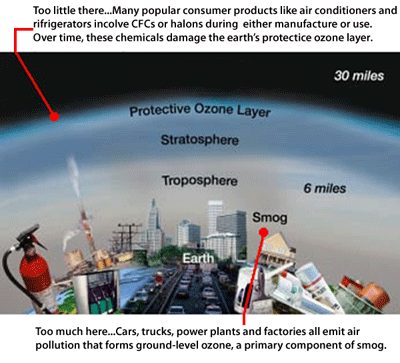
 Ground level Ozone: Ground level Ozone:
Or Smog is located in the troposphere, or the air closest to the earths surface. Ground-level ozone has the same chemical structure as that of Ozone located higher
in the atmosphere. Ground-level Ozone is an air pollutant that damages human health along with crops, trees and other vegitation. Ground-level ozone is formed when two types of pollutants react in the presence of sunlight. This Ozone is created chemically from many factors such as Motor Vehicle Exhaust and Industrial Emissions,
Gasoline Vapors, as well as Natural Sources that omit NOx and VOC into the air. Sunlight and warm weather can cause harmfull concentrations in the air which is why Air Quality is particularly dangerous during summer months. The air we
breathe is made up of Two oxygen atoms(O2) while Ozone is made up of three oxygen atoms(O3) making it increasingly dangerous to breathe. This is why it is important to monitor the air quality
Stratosphere Ozone:
This is Ozone located 6-30 miles up in the air in the stratosphere. This layer blocks harmful UV rays from reaching the earths surface. See UV radiation Page
This is also known as "good Ozone"
|


 Air Quality


 Foresthill Weather.com
Welcome
Foresthill Weather.com
Welcome






















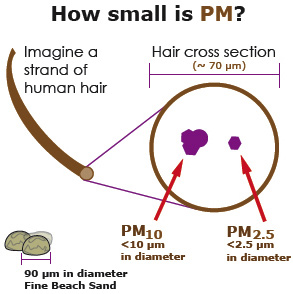 PM2.5 which incudes all sizes up to 2.5
is the most dangerous because it cause more damage to the lung than larger particules. When you cough or swallow your body is trying to get rid of particulate matter that has been trapped in your lung by mucous that was produced for that job.
Tiny hairs move the mucous and particles out of the lungs to the back of the throat where you then will cough it out. Smaller particles however, cannot be moved out of the lungs but become trapped by special cells that keep them there.
If these toxic particles do become trapped in the lungs, they can cause lung disease, lung cancer, emphysema, etc. Though the smaller particles may cause the most damage to the lungs, both PM2.5 and PM10 can cause a series of respiratory
health problems (occurring within the lungs and airway). Due to the fact that PM2.5 is smaller and often much more toxic (metals and cancerous material) than PM10 it causes more damage to the lungs because it travels deeper.
PM2.5 which incudes all sizes up to 2.5
is the most dangerous because it cause more damage to the lung than larger particules. When you cough or swallow your body is trying to get rid of particulate matter that has been trapped in your lung by mucous that was produced for that job.
Tiny hairs move the mucous and particles out of the lungs to the back of the throat where you then will cough it out. Smaller particles however, cannot be moved out of the lungs but become trapped by special cells that keep them there.
If these toxic particles do become trapped in the lungs, they can cause lung disease, lung cancer, emphysema, etc. Though the smaller particles may cause the most damage to the lungs, both PM2.5 and PM10 can cause a series of respiratory
health problems (occurring within the lungs and airway). Due to the fact that PM2.5 is smaller and often much more toxic (metals and cancerous material) than PM10 it causes more damage to the lungs because it travels deeper.







)
)